
The Remarkable Journey Electricity Takes Before It Reaches You
Every time you flip a switch, something remarkable has already happened.
Before that light comes on, before your phone begins to charge, before your business powers up for the day, electricity has completed a long, precisely coordinated journey across hundreds of kilometers of infrastructure, passing through multiple systems and the hands of thousands of engineers and technicians working in concert.
Most people never think about it. But understanding that journey changes how you see your power supply and why, sometimes, it behaves the way it does.
It Begins Far From Your Street
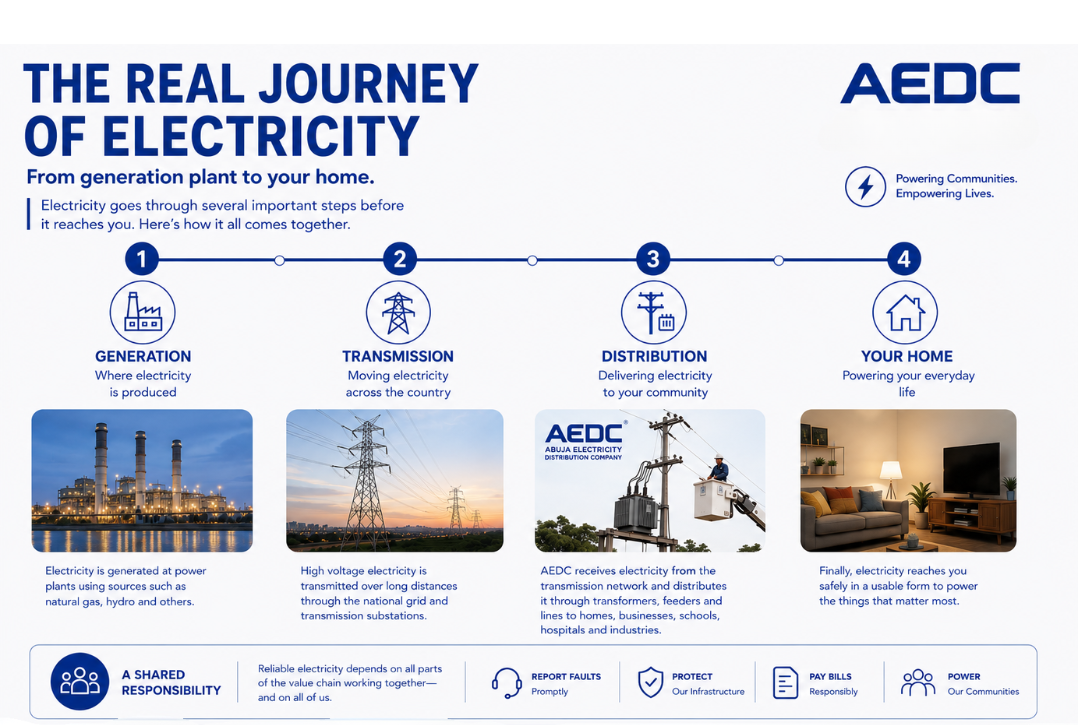
Electricity does not originate at your local transformer or even at your distribution company. It begins at a generating plant: facilities powered by natural gas, hydroelectric dams, or other energy sources located across the country, often far from the cities and communities they serve.
At these plants, raw energy is converted into electrical power and immediately pushed into the national grid at extremely high voltages. High voltage is not a hazard at this stage. It is a necessity. The higher the voltage, the less energy is lost over long distances. Physics, not policy, dictates that electricity must travel this way.
At this point, the power that will eventually light your home is still hundreds of kilometers away, moving through infrastructure most Nigerians will never see.
The National Highway of Power
From the generating plant, electricity enters the transmission network: the high-voltage backbone of Nigeria’s entire electricity system.
Think of it as a national highway for electrical energy. Massive transmission towers carry bulk power across states and regions through interconnected lines and substations, stepping voltage up and down as needed to move electricity efficiently across vast distances.
This network connects every generating plant in the country to every distribution company serving every community. It is, by design, deeply interconnected, which means its strengths are shared across the system, and so, occasionally, are its pressures.
By the time electricity exits the transmission network, it has already crossed terrain, weather systems, and state boundaries to arrive at the edge of your city.
The Last Mile: Where Distribution Begins
This final stage, distribution, is where electricity makes the transition from bulk national infrastructure to the neighbourhood level.
Distribution companies receive high-voltage power through injection substations and step it down to safe, usable voltages before delivering it through a local network of transformers, feeders, poles, underground cables, and metering systems to homes, businesses, schools, hospitals, and markets.
This last mile is the most complex part of the journey in many ways. It covers the most ground, serves the most people directly, and requires the most granular maintenance and operational attention. A transmission line might serve an entire region. A distribution transformer serves your street.
Why the Whole Chain Matters
Here is the part that most customers are never told, and that explains a great deal about how electricity supply works in practice.
All three stages, generation, transmission, and distribution, must function well simultaneously for power to reach you reliably. A shortfall at any point in the chain affects everything downstream from it.
If national generation output drops significantly, less electricity enters the transmission network. If a transmission fault disrupts bulk supply into a region, every distribution network in that region feels it, regardless of how well-maintained local infrastructure is. And faults at the distribution level, from storm damage to overloaded transformers, affect the specific communities those assets serve.
This is not a system where one party controls all outcomes. It is a value chain, and its performance is the sum of every link within it.
What You Can Do
Understanding the complexity of this system is the first step. The second is recognising that communities are not passive recipients in it. They are active participants.
The network that delivers electricity to your home is shared infrastructure. How it is treated determines, in part, how well it performs.
Reporting damaged poles, hanging cables, or exposed infrastructure promptly helps technical teams respond before small faults become large ones. Avoiding construction near power line corridors protects the network from avoidable damage. Discouraging illegal connections and energy theft in your community preserves the stability of a system that everyone depends on. And paying electricity bills on time sustains the investment cycle that keeps the infrastructure functioning and improving.
Reliable electricity is not maintained by engineers alone. It is maintained by everyone who uses it.
The next time your lights come on, remember that electricity has already travelled an extraordinary journey across a vast national network before reaching your home; a journey worth appreciating.
