
Bands A, B, C, D and E: Your Electricity Service Band Explained Simply
Let’s be honest. Most people have heard the words “service band” thrown around, seen them on social media or in a news headline, and quietly moved on without fully understanding what it means. But your service band actually affects your electricity experience in ways worth understanding. So let’s walk through it together, simply and clearly.
Think of It as a Supply Expectation
At its core, a service band is just a way of saying: on average, how many hours of electricity supply should your area be receiving each day?
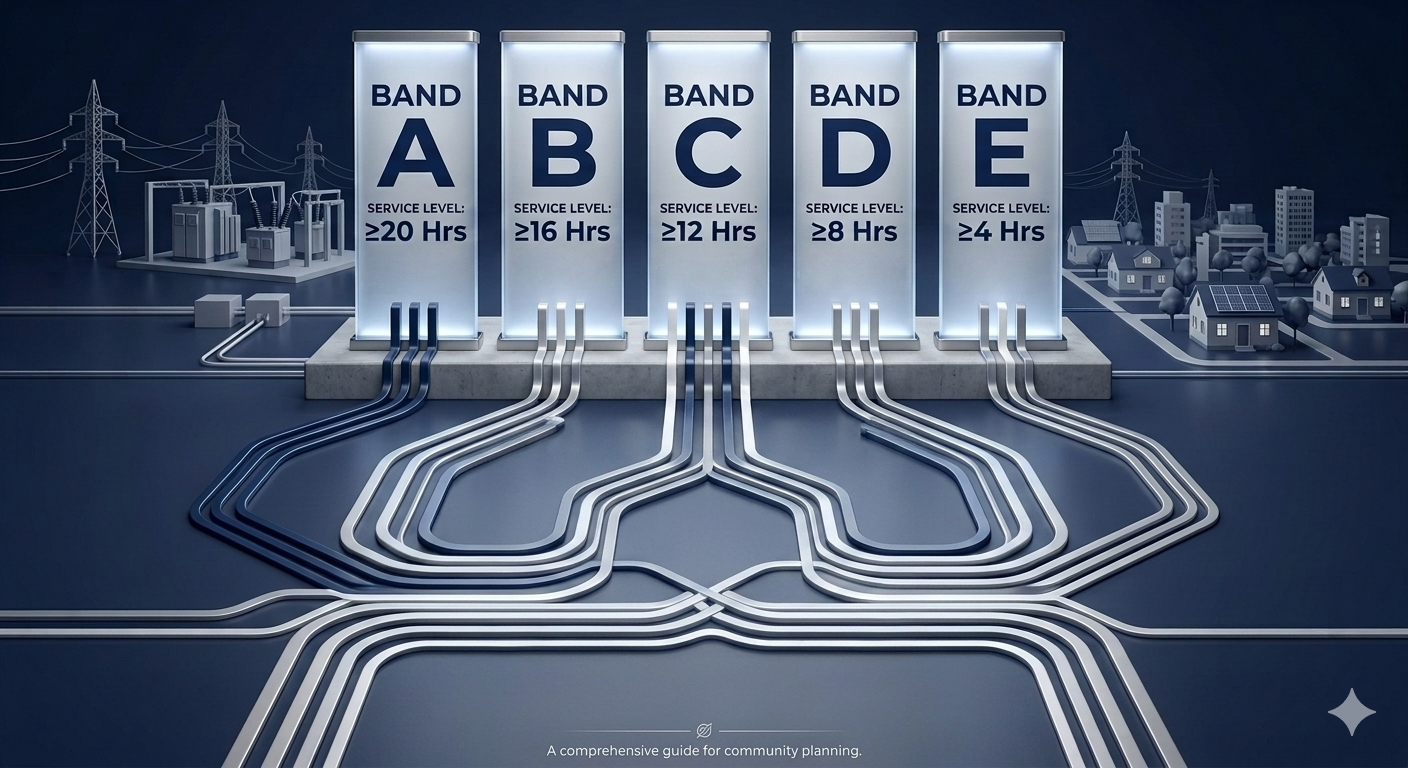
That’s it. No complicated formula. No mystery. Just an expected daily supply range, grouped into five categories:
Band A — at least 20 hours a day
Band B — at least 16 hours a day
Band C — at least 12 hours a day
Band D — at least 8 hours a day
Band E — at least 4 hours a day
Your band is determined by the feeder that serves your area — a feeder being the electrical line that carries power from a substation into your neighbourhood. Each feeder has its own technical profile, and that profile informs its classification.
Why Different Communities Can Be on Different Bands
This is one of the most common questions customers ask.
The simple answer is that not all communities are served by the same feeder. Electricity is delivered through a network of feeders, transformers, and substations, each with its own technical characteristics, infrastructure condition, and supply profile.
A feeder is the distribution line that carries power from a substation to a particular area. Different communities, estates, districts, or locations may be connected to different feeders, even when they are relatively close to one another.
Because service bands are assigned based on feeder performance and the average hours of supply a feeder delivers, areas served by different feeders can fall into different bands. This reflects the realities of the network and the level of supply available to each feeder under normal operating conditions.
In other words, band classifications are tied to the feeder serving an area, not simply to geographical proximity. Two nearby communities may therefore have different service bands because they are connected to different parts of the electricity network.
Why Your Band Affects Your Tariff
Simply put: the more supply you receive, the different the tariff category you fall under. A customer receiving up to 20 hours of electricity a day is in a very different situation from one receiving 4 hours. The tariff structure is designed to reflect that difference in service level. It is the regulator’s way of trying to align what customers pay with what they actually receive.
Here Is the Part Most People Do Not Know
Your band is not fixed forever.
As infrastructure in your area improves through network upgrades, transformer reinforcement, or feeder rehabilitation, feeders get reassessed. A community that was previously classified lower can move up as supply conditions genuinely improve.
This means the band system is not a ceiling. It is a snapshot of where things currently stand. And snapshots change.
How to Find Out Your Band
Your service band can be confirmed through AEDC’s official customer service channels. Because band classifications are tied to specific feeder and network configurations, it is always better to verify through official sources rather than going by neighbourhood word of mouth, which is not always accurate.
The Bottom Line
What the band system provides is a framework; a way of setting clear expectations, creating accountability, and giving customers a basis for understanding their supply.
But here is the most important thing to take away: a band is a starting point, not a final verdict. Infrastructure grows. Networks improve. Communities that once sat at the lower end of the scale have moved up, and more will continue to do so.
So know your band, understand what it means, and know that the direction of travel is always toward better.
